
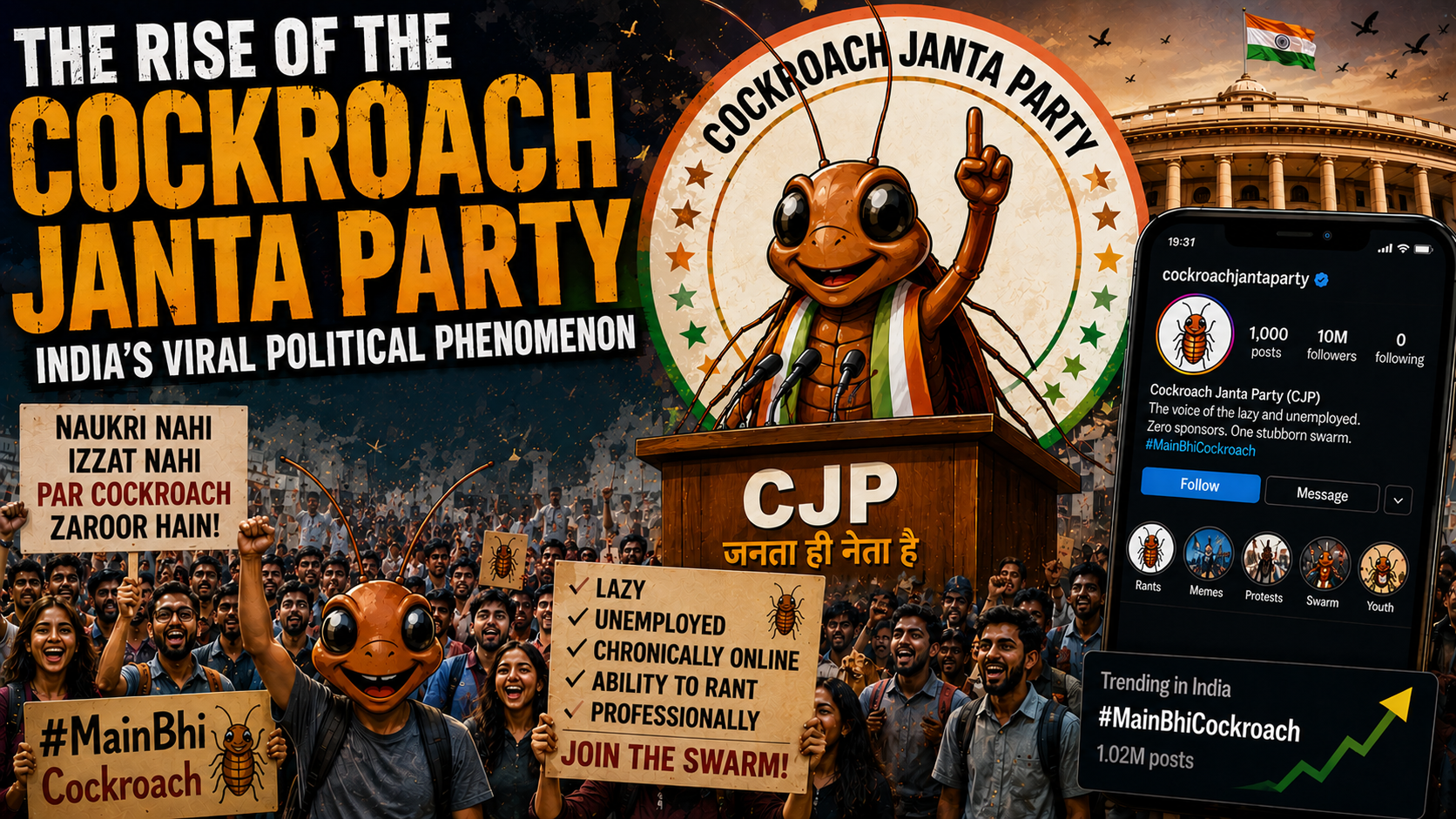
India’s New Political Superstar Isn’t a Politician; It’s a Cockroach
Highlights
- A satirical online movement called the Cockroach Janta Party (CJP) has rapidly gained national attention, attracting millions of followers within days of its launch.
- The movement emerged after controversial remarks by Surya Kant sparked widespread debate across social media.
- Created by Abhijeet Dipke, the CJP uses humor, memes, and political satire to channel frustration among young Indians.
- The collective has attracted support from opposition figures, activists, and young social media users while also drawing criticism from political opponents.
- Despite its viral success, the CJP remains an online movement rather than a formal political organization.
Key Takeaways
- Political satire is becoming a powerful form of engagement: Younger audiences increasingly use humor and internet culture to discuss public issues.
- Youth frustration fuels digital movements: Concerns about employment, representation, and economic opportunity are driving online political participation.
- Social media can rapidly create political phenomena: The CJP’s growth demonstrates the speed at which digital communities can mobilize.
- Meme culture is reshaping political discourse: Online movements increasingly blend entertainment, criticism, and activism.
- Virality does not automatically translate into political power: The movement’s long-term influence remains uncertain beyond social media platforms.
Core Background
India’s latest political talking point is neither a traditional political party nor a grassroots protest movement. Instead, it is a satirical online collective built around one of society’s most unlikely symbols: the cockroach.
The Cockroach Janta Party (CJP) emerged after remarks attributed to Chief Justice Surya Kant triggered widespread discussion online. While the comments later received clarification, they had already inspired a wave of memes, criticism, and political satire.
The movement was launched by Abhijeet Dipke, who initially presented the idea as a humorous response to the controversy. What began as an online joke quickly evolved into a viral phenomenon, attracting millions of followers, widespread media coverage, and endorsements from opposition leaders and public figures.
Unlike conventional political organizations, the CJP operates through internet culture. Its messaging embraces self-deprecating humor, parody membership campaigns, viral hashtags, and satirical political commentary aimed largely at younger audiences.
The movement’s popularity reflects broader concerns among many young Indians regarding employment opportunities, economic pressures, political representation, and civic participation. Although India has one of the world’s youngest populations, many younger citizens remain disengaged from traditional party politics.
Supporters view the CJP as a creative outlet for expressing frustrations that often feel ignored in mainstream political discourse. Critics, however, argue that the movement is largely symbolic and may represent digital activism more than substantive political change.
Regardless of its future trajectory, the CJP highlights a growing trend in modern politics: the fusion of memes, social media culture, and civic expression. In an era where political conversations increasingly unfold online, humor has become a vehicle for discussing serious social and economic concerns.
The rise of the Cockroach Janta Party suggests that for many young citizens, political engagement no longer begins with rallies or manifestos—it starts with a hashtag, a meme, and a community built on shared frustrations.