
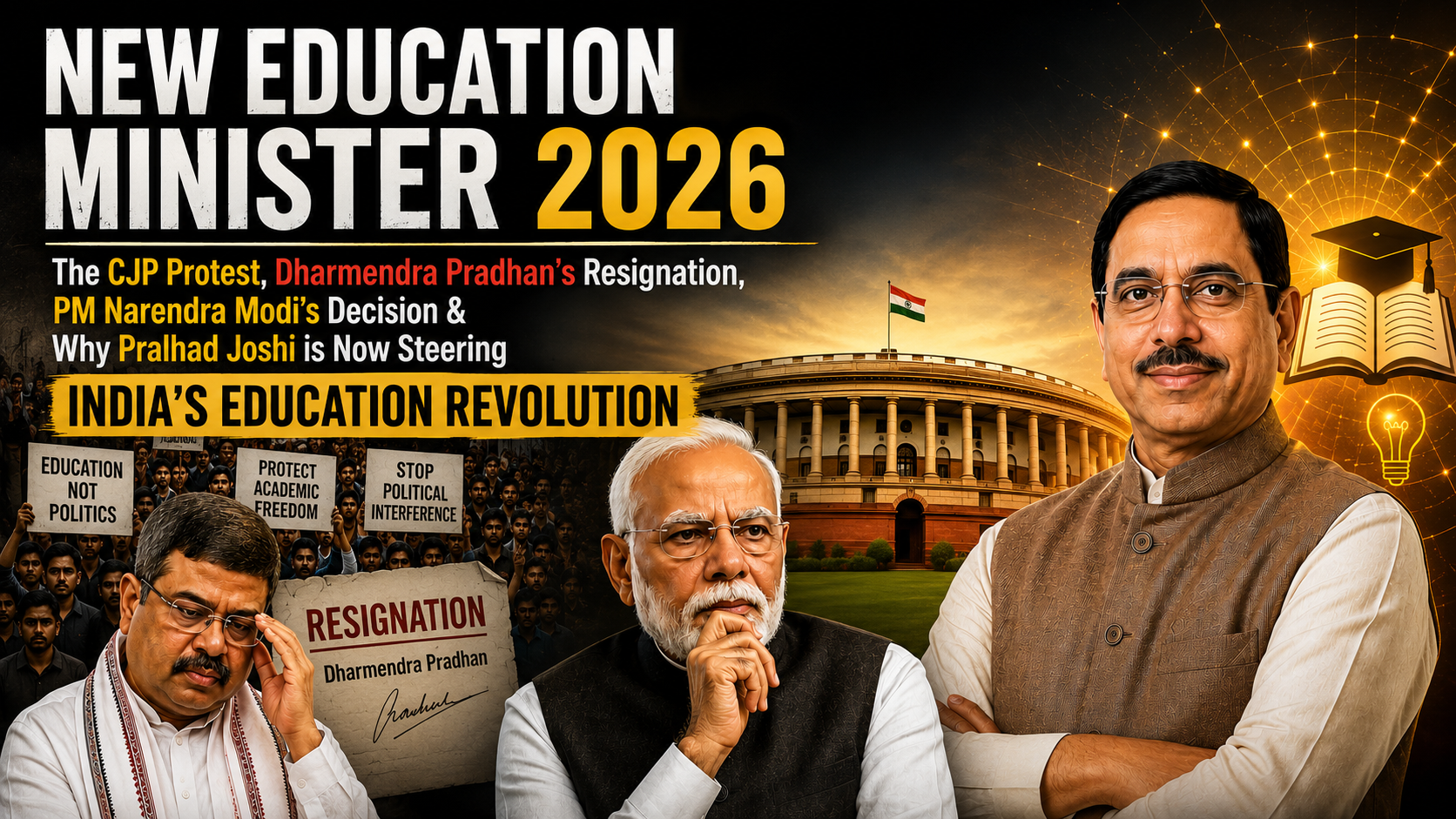
When an Examination Crisis Became a Political Earthquake
By Editorial Desk, The Magnate Network
A Political Storm That Began in the Examination Hall
India has witnessed ministerial resignations before. It has witnessed student protests before. It has even witnessed controversies over competitive examinations. Yet, what unfolded during the summer of 2026 was unlike anything the country’s education system had experienced in decades.
What began as allegations surrounding the NEET-UG 2026 examination gradually evolved into a nationwide movement questioning the integrity of India’s examination ecosystem. Within weeks, the debate had moved beyond leaked question papers and administrative lapses. It became a larger conversation about merit, accountability, governance, and the relationship between young citizens and the state.
At the center of this storm stood Union Education Minister Dharmendra Pradhan, who had overseen the Ministry of Education since 2021. For months, his ministry defended its handling of the situation, arguing that investigations were underway, reforms had already begun, and isolated incidents should not undermine confidence in the entire examination system. However, public anger continued to grow.
Student demonstrations spread across states, digital campaigns gathered momentum, and a youth-led movement known as the Cockroach Janta Party (CJP) transformed from an internet phenomenon into a powerful force on the streets.
Eventually, Dharmendra Pradhan resigned. Soon after, Prime Minister Narendra Modi advised the President to assign the Education Ministry to senior Cabinet minister Pralhad Joshi, while simultaneously announcing a broad reform agenda aimed at restoring trust in India’s examination process.
But this sequence of events raises a series of deeper questions.
Was the resignation merely an act of ministerial accountability? Was it a strategic political decision designed to de-escalate a rapidly expanding movement? Or did it represent something more profound, a recognition that public confidence in one of India’s most important institutions had been fundamentally shaken?
This study reconstructs the crisis, separates verified events from political interpretation, and examines how India reached a moment where education policy became one of the defining political stories of 2026.
Understanding the Crisis: Why Education Became a National Political Issue
Competitive examinations occupy a unique position in India.
Unlike many developed economies, where multiple pathways exist for higher education and employment, India relies heavily on centralized examinations to allocate opportunities. A single score can determine admission to medical colleges, engineering institutes, government jobs, and other prestigious institutions.
For millions of families, these examinations represent more than academic milestones; they symbolize social mobility, financial security, and years of sacrifice.
When the integrity of that system is questioned, the consequences extend far beyond education.
The controversy surrounding NEET-UG 2026 therefore struck at the heart of public confidence. Reports of alleged paper leaks, irregularities, and questions over examination security reignited longstanding concerns about the vulnerability of India’s testing infrastructure. While investigations sought to establish the extent of malpractice, public perception evolved much faster than official inquiries.
For students who had devoted years to preparation, the issue was not simply whether a particular examination had been compromised. It was whether merit itself remained protected.
That perception proved politically significant.
From Administrative Controversy to National Movement
Many government controversies remain confined to parliamentary debates or television studios.
This one did not.
Instead, it moved directly into universities, coaching centers, hostels, public squares, and social media platforms.
Students began asking difficult questions:
- If examination papers can leak, what happens to honest candidates?
- Can future examinations be trusted?
- Who is accountable when institutional safeguards fail?
- Should responsibility remain limited to investigative agencies, or should political leadership also accept accountability?
These questions resonated because they reflected a broader anxiety among India’s youth.
The country’s demographic dividend has often been described as one of its greatest strengths. Yet, for that dividend to translate into economic growth, young citizens must believe that opportunities are distributed fairly.
Once confidence in that belief weakens, frustration can quickly transform into political mobilization.
The Emergence of the Cockroach Janta Party (CJP)
Perhaps the most unexpected development of the entire episode was the rise of the Cockroach Janta Party, commonly known as the CJP. Unlike traditional political organizations, CJP did not emerge through conventional party structures. Its origins lay in internet culture, satire, memes, digital activism, and student-led conversations that initially appeared unlikely to influence national politics.
However, the movement gradually acquired characteristics associated with organized civic campaigns:
- decentralized leadership,
- widespread volunteer participation,
- strong digital coordination,
- peaceful public demonstrations,
- clear institutional demands rather than ideological slogans.
Its symbolism also proved remarkably effective.
Rather than presenting itself as another opposition movement, CJP masqueraded as a voice for students who believed they had been overlooked by institutions responsible for protecting merit.
This distinction helped broaden its appeal beyond conventional political affiliations. As demonstrations expanded, participation increasingly included parents, educators, civil society groups, and professionals who viewed examination integrity as a national issue rather than merely a student grievance.
Why the Protests Resonated Across India
Political movements succeed only when they connect individual frustrations to a larger public narrative.
CJP targeted exactly that.
Its messaging shifted attention away from one examination and toward a broader concern:
Can India’s education system guarantee fairness in an era where technology, organized fraud, and institutional complexity have made examination security increasingly difficult?
That question resonated because nearly every Indian family has some connection to competitive examinations.
Whether through NEET, JEE, CUET, UPSC, SSC, banking examinations, railway recruitment, or state-level entrance tests, examination credibility affects millions of households.
Consequently, the protests became about trust, not simply about one ministry.
The Government’s Initial Position
From the beginning, the Union Government maintained that the allegations required careful investigation rather than immediate political conclusions.
Officials argued that:
- isolated incidents should not invalidate the entire examination system;
- law-enforcement agencies were actively investigating organized paper leak networks;
- institutional reforms were already under consideration;
- technological safeguards would continue to be strengthened.
The government consistently emphasized that accountability should follow evidence rather than public speculation.
This position reflected a familiar governing principle: avoid major administrative decisions until investigations establish responsibility.
However, while that approach may have been procedurally sound, it encountered a political challenge.
Public opinion was evolving faster than institutional processes.
As investigations continued, students increasingly judged the government not by legal findings but by visible leadership.
That distinction would eventually become one of the defining features of the crisis.
When Public Perception Begins to Outpace Official Action
Modern political crises rarely unfold inside government offices.
They unfold simultaneously across television channels, social media platforms, WhatsApp groups, university campuses, and digital communities. By mid-2026, every new development related to examination irregularities reinforced a broader perception that confidence in the system had weakened.
Whether entirely justified or not, perception itself became politically consequential.
Political history repeatedly demonstrates that governments are often required to respond not only to proven administrative failures but also to crises of public confidence.
In this case, the central question gradually shifted.
Instead of asking:
“Did irregularities occur?”
The national conversation became:
“Has confidence in India’s examination system been damaged?”
That subtle change dramatically altered the political landscape.
Because while investigations determine legal accountability, public confidence determines political accountability.
And once those two timelines diverge, governments face difficult choices.
The Turning Point: When an Administrative Crisis Became a Leadership Question
Every government faces crises.
Some are managed through investigations. Others through policy corrections. A few demand a change in leadership, not necessarily because an individual has been found personally responsible, but because public confidence in an institution has eroded to a point where political accountability becomes inseparable from administrative recovery.
By the third week of July 2026, the debate surrounding India’s examination system had entered precisely that stage.
The conversation was no longer limited to alleged paper leaks or examination malpractice. Instead, it had evolved into a national referendum on trust.
For the Government of India, this presented a complex challenge.
On one hand, investigative agencies were continuing their inquiries, and the legal process had not established personal wrongdoing by Union Education Minister Dharmendra Pradhan. On the other hand, millions of students, parents, and educators increasingly viewed the crisis through a political lens rather than a legal one.
History often demonstrates that democratic governments are judged as much by perception as by procedure.
The Education Ministry had become the visible face of a crisis that extended far beyond any single examination.
Why Dharmendra Pradhan Resigned: Understanding Political Accountability
One of the most searched questions following the cabinet reshuffle has been:
Why Dharmendra Pradhan Resigned
The simplest answer is also the most nuanced.
Officially, the resignation represented a ministerial transition amid a major national controversy over examination governance. Public reporting indicates that the resignation came after weeks of sustained protests and increasing demands for accountability, after which Prime Minister Narendra Modi advised the President to accept Pradhan’s resignation and reassign the portfolio.
However, politics rarely operates on a single explanation.
To understand the decision, it is helpful to separate established facts from political analysis.
Verified Facts:
The following developments are supported by public reporting:
- Student protests intensified across multiple states.
- Examination integrity became a dominant national issue.
- Dharmendra Pradhan resigned from the Union Cabinet.
- President Droupadi Murmu accepted the resignation on the advice of the Prime Minister.
- Senior Cabinet Minister Pralhad Joshi was assigned charge of the Ministry of Education.
- The Government announced measures aimed at strengthening examination reforms and restoring public confidence.
Everything beyond these events enters the realm of political interpretation.
Three Analytical Scenarios Behind the Resignation
Political decisions, especially cabinet reshuffles, are rarely explained in detail by governments.
As a result, analysts typically examine the broader context.
Three major interpretations emerged following Dharmendra Pradhan’s resignation.
Scenario One: Ministerial Accountability
The first interpretation is rooted in the Westminster model of parliamentary democracy.
Under this convention, ministers are expected to assume political responsibility for significant failures occurring within their departments, even if they are not personally involved.
This principle differs fundamentally from criminal or legal liability.
Political accountability focuses on institutional responsibility.
Supporters of this interpretation argue that the resignation was intended to demonstrate that public institutions remain accountable to citizens. From this perspective, changing the minister was less about assigning blame and more about restoring confidence. Governments across parliamentary democracies have, at various times, accepted ministerial resignations following administrative crises despite the absence of personal misconduct.
Viewed through this lens, the resignation was an attempt to reset public confidence in the Ministry rather than an acknowledgment of individual wrongdoing.
Scenario Two: A Strategic Political Reset
A second interpretation views the resignation as a strategic political decision.
By late July, the controversy had begun dominating national discourse.
Media coverage increasingly focused not merely on examination reforms but on demands for ministerial accountability. Every new protest shifted attention away from government initiatives and toward questions regarding leadership.
Political strategists often argue that allowing a controversy to revolve around one individual can prevent attention from shifting toward policy solutions.
Replacing the minister, therefore, achieves several objectives simultaneously:
- It acknowledges public concern.
- It changes the political narrative.
- It creates space for institutional reforms.
- It allows the incoming minister to begin with comparatively greater public goodwill.
From this perspective, the resignation represented political crisis management rather than admission of failure.
Scenario Three: Preparing for Structural Reform
A third interpretation focuses on governance rather than politics.
The examination controversy exposed structural weaknesses that had accumulated over several years. Regardless of which government was in power, experts had repeatedly highlighted challenges, including:
- Digital security vulnerabilities.
- Coordination among examination agencies.
- State-level implementation differences.
- Organized paper leak networks.
- Delays in investigations.
- Weak public communication during crises.
Addressing these issues would likely require reforms extending beyond routine administrative measures. Appointing a new minister can sometimes symbolize the beginning of a broader institutional overhaul. This interpretation aligns with the Government’s subsequent emphasis on systemic examination reforms rather than isolated disciplinary action.
The Government’s Stand: Reform, Not Panic
Throughout the controversy, the Union Government consistently maintained that India’s examination system remained fundamentally robust despite the alleged irregularities.
Its public position rested on several key arguments.
First, officials emphasized that instances of malpractice should not undermine confidence in millions of examinations conducted successfully across the country every year.
Second, the Government argued that investigations should determine responsibility rather than public speculation.
Third, it maintained that technological modernization would remain central to examination reforms.
Following the leadership transition, the Prime Minister announced a series of measures intended to strengthen the examination ecosystem, including the establishment of an expert task force, greater use of technology, enhanced coordination among agencies, and stricter action against organized examination fraud.
These measures were presented as long-term structural reforms rather than temporary responses to political pressure.
The Government’s messaging sought to communicate two ideas simultaneously:
- The administration was prepared to acknowledge public concern.
- The solution lay in institutional reform rather than loss of confidence in the education system itself.
The Prime Minister’s Intervention
Major administrative crises eventually reach a point where intervention from the country’s highest political leadership becomes inevitable.
According to official announcements, Prime Minister Narendra Modi chose not merely to fill a ministerial vacancy but to frame the episode as an opportunity for comprehensive examination reform.
That decision altered the narrative.
Instead of allowing the resignation to dominate headlines indefinitely, attention shifted toward questions such as:
- How should examinations be redesigned?
- What technological safeguards are necessary?
- How can public confidence be rebuilt?
- Should penalties for organized examination fraud become more stringent?
Politically, this represented an attempt to move the conversation from who was responsible to what comes next.
Such shifts are common during periods of governance reform.
Once accountability has been demonstrated through administrative action, governments often seek to redirect public debate toward future solutions.
A Defining Lesson in Democratic Accountability
The events of 2026 also illustrate a broader principle of democratic governance. Legal accountability and political accountability do not always move on the same timeline. Investigations may require months to establish facts. Public confidence can shift within days. Governments must often navigate this tension carefully. Respond too quickly, and they risk appearing to prejudge investigations. Respond too slowly, and they risk allowing public trust to deteriorate further.
The leadership transition within the Ministry of Education appears, at least in part, to have been an effort to bridge that gap, maintaining respect for due process while responding to a rapidly evolving political environment.
Whether that balance succeeds will depend not on the resignation itself, but on the reforms that follow.
From Accountability to Renewal
By the time Dharmendra Pradhan left office, the central issue had evolved beyond one minister or one examination.
India faced a broader challenge:
How could the world’s largest democracy preserve faith in one of the world’s largest competitive examination systems?
That question would soon fall to a new leader.
Within hours of the resignation, Prime Minister Modi entrusted the Ministry of Education to Pralhad Joshi, a seasoned parliamentarian known more for administrative coordination than education policy. The appointment surprised many observers.
Yet, as the next chapter reveals, it may also have reflected a carefully considered choice.
A New Face, A Familiar Administrator
When the Government announced that Pralhad Joshi would assume charge of the Ministry of Education, the reaction was mixed.
For many, the appointment came as a surprise.
Unlike several of his predecessors, Pralhad Joshi has not built his political identity around education policy. His public career has largely been associated with parliamentary management, food and consumer affairs, renewable energy, coal, and mines. He has earned a reputation inside the government as an experienced administrator, an effective parliamentary strategist, and a minister capable of handling complex portfolios with minimal public controversy.
That immediately raised a question across political circles:
Why would the Prime Minister choose someone without an extensive education-policy background to lead one of the country’s most scrutinized ministries?
The answer may lie less in education policy and more in crisis management.
Why Pralhad Joshi? Understanding the Government’s Possible Thinking
Like every Cabinet appointment, the Government has not publicly disclosed the internal deliberations behind the decision. Therefore, any attempt to answer this question must remain analytical rather than definitive.
Nevertheless, the appointment appears consistent with several practical considerations.
1. Restoring Administrative Confidence
The Ministry of Education was not simply dealing with an academic controversy.
It was managing:
- a nationwide political movement,
- public anger,
- institutional reform,
- coordination with investigative agencies,
- communication with states,
- and confidence among nearly forty million students preparing for future examinations.
Such a situation requires administrative stability as much as policy expertise.
Pralhad Joshi’s long experience within the Union Cabinet suggests that the Government prioritized organizational leadership over subject specialization. In moments of institutional stress, governments often select ministers known for execution rather than experimentation.
2. A Fresh Political Beginning
Political crises frequently become associated with individuals rather than institutions. Replacing leadership allows governments to communicate that the next phase will be different.
Whether fair or unfair, Dharmendra Pradhan’s public image had become closely linked with the examination controversy. Even if reforms continued under his leadership, public debate might have remained focused on past events. A new minister changes that equation.
Every reform announced by the new leadership becomes associated with renewal instead of damage control. This does not erase the previous controversy. But it does allow the Government to begin a new chapter.
3. Reforming the National Testing Ecosystem
Experts have repeatedly argued that examination reform requires structural modernization rather than isolated corrective action.
Possible areas include:
- encrypted digital paper distribution,
- AI-assisted anomaly detection,
- stronger cybersecurity,
- independent auditing,
- biometric verification,
- standardized emergency response protocols,
- real-time monitoring of examination centers.
Several of these measures have already been discussed within policy circles.
The challenge now lies in implementation.
4. Legislative Reform
The Government has already indicated its intention to strengthen legal provisions against organized examination fraud.
Future legislative measures could include:
- harsher penalties,
- financial investigation of organized cheating networks,
- stronger digital surveillance,
- national coordination mechanisms,
- enhanced accountability for examination contractors.
If implemented effectively, these reforms could significantly alter the landscape of competitive examinations in India.
What Does This Mean for Students?
For students, political developments matter only if they produce practical change.
Their expectations are straightforward.
They want examinations that are:
- fair,
- transparent,
- secure,
- timely,
- free from organized malpractice.
Students are unlikely to evaluate the Government solely by speeches or announcements.
Instead, they will judge success through experience.
Future NEET, JEE, CUET, UPSC, SSC, banking, railway, and state examinations will become the real measure of whether confidence has been restored.
Beyond Politics: A Lesson About Public Trust
One of the most important lessons from this episode extends beyond any individual minister.
Public institutions derive authority from trust.
Once trust weakens, restoring it requires far more than administrative corrections.
Education occupies a particularly sensitive place in democratic societies because it represents opportunity.
When citizens begin questioning whether opportunity remains fair, governments face challenges that extend beyond education policy.
The events of 2026, therefore, reveal something larger.
They demonstrate that institutional credibility has become one of the defining political issues of modern governance.
Now, The Primary Question: Did the CJP Protest Change Indian Politics?
Perhaps.
Whether intentionally or not, the Cockroach Janta Party (CJP) demonstrated the growing influence of decentralized, digitally organized civic movements.
Unlike conventional political campaigns, CJP relied heavily on:
- social media,
- satire,
- volunteer coordination,
- youth participation,
- decentralized leadership.
Its ability to transform online conversations into sustained public demonstrations reflects broader changes in political participation among younger generations.
Future governments, regardless of political affiliation, are likely to study this movement carefully. The methods used by CJP may influence civic activism well beyond education.
Looking Ahead: What Success Will Actually Look Like
If the reforms succeed, India may witness:
- fewer examination controversies,
- stronger cybersecurity,
- improved transparency,
- greater public confidence,
- better coordination among agencies,
- quicker investigations,
- stronger action against organized fraud.
Ironically, the greatest indicator of success may be the absence of headlines. When examinations proceed smoothly, public attention naturally shifts elsewhere. That is precisely the outcome the current BJP Government hopes to achieve.
The Bigger Picture
While headlines have focused on Why Dharmendra Pradhan Resigned, the deeper story is not about one resignation.
Nor is it solely about one appointment.
The real story concerns the evolution of democratic accountability. Students demanded confidence. The Government responded through leadership change and promises of institutional reform. Whether those reforms meet public expectations will determine how historians ultimately remember the summer of 2026.
If examination integrity improves substantially, the crisis may eventually be viewed as a painful but transformative moment. If similar controversies continue, the resignation will instead be remembered as merely one chapter in a much larger institutional challenge.
Frequently Asked Questions
Who is the New Education Minister 2026?
Following the resignation of Dharmendra Pradhan, Pralhad Joshi was appointed to lead the Ministry of Education, bringing extensive Cabinet and parliamentary experience to the role.
Why Did Dharmendra Pradhan Resign?
The resignation followed weeks of nationwide protests over examination integrity. While there has been no official finding of personal wrongdoing directly against him, the Government accepted his resignation amid mounting public pressure and subsequently announced broader examination reforms.
What Was the CJP Protest?
The Cockroach Janta Party (CJP) masqueraded as a youth-driven movement advocating for transparency, accountability, and stronger safeguards against examination malpractice. Through online campaigns and public demonstrations, its role elevated concerns over examination integrity into a national political issue.
What Are the Government’s Next Steps?
The Government has announced plans to strengthen the examination system through institutional reforms, technological safeguards, enhanced coordination among agencies, and stricter action against organized examination fraud. The long-term success of these initiatives will depend on effective implementation.
Conclusion: A Crisis That May Reshape Indian Education
Every generation experiences defining political moments. Some are remembered because governments changed. Others because institutions changed.
The events surrounding the CJP protest, Why Dharmendra Pradhan Resigned, Prime Minister Narendra Modi’s intervention, and the appointment of Pralhad Joshi as the New Education Minister 2026 will likely be remembered not simply as a Cabinet reshuffle, but as a pivotal test of how India’s democratic institutions respond when public trust is challenged.
The resignation marked the end of one political chapter. The appointment of a new minister signaled the beginning of another. Yet the true measure of success will not be found in parliamentary announcements or cabinet notifications. It will be determined in examination halls across the country, where millions of students continue to place their faith in a system they expect to be fair, transparent, and merit-driven.
If the reforms deliver on those expectations, 2026 may ultimately be seen as the year India strengthened the foundations of its education system. If they do not, the questions raised during this crisis will continue to echo long after the headlines have faded.
For now, one thing is certain: the conversation has moved beyond personalities. It is now about the future of India’s education system itself.
Disclaimer-
This article has been prepared for informational and editorial purposes based on publicly available information gathered from various online sources, including Google search results, Wikipedia, official statements, news reports, and other publicly accessible references available at the time of writing.
While every reasonable effort has been made to verify the information used, we do not warrant or guarantee that all facts, statements, timelines, or interpretations are complete, current, or 100% accurate. Some information may change as new developments emerge or additional official confirmations become available.
The views, analyses, interpretations, and conclusions presented in this article are intended to encourage discussion and should be regarded as editorial opinion rather than definitive statements of fact. Readers are advised to verify important information through official government notifications, authorized sources, or other primary references before relying on the content for any personal, legal, financial, academic, or professional purpose.
The publisher, editorial team, and authors disclaim any liability for errors, omissions, or consequences arising from the use of this information. References to third-party sources are made solely for research and informational purposes and do not imply endorsement by or affiliation with those sources.