
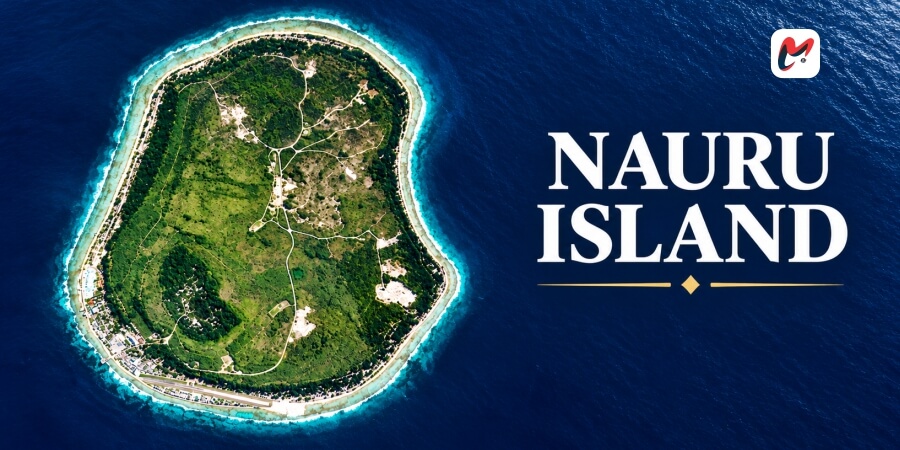
A familiar name has changed in the Pacific. In 2026, the country long known internationally as Nauru officially adopted Naoero as its name, bringing its formal designation closer to the traditional name used in the local language. The change is more than a spelling adjustment. It touches language, history, national identity and the way the small Pacific state presents itself internationally. For anyone searching for Nauru Island today, the geography remains exactly where it was, but the country’s official name has entered a new chapter.
The government now refers to the state as the Republic of Naoero, while its citizens are officially described as dei-Naoero. The international country code is also changing from NRU to NRO. The decision was formalized through a constitutional amendment passed by Parliament in May 2026, and the government announced the new designation publicly in July.
Why Nauru Became Naoero
The story behind the change goes back much further than 2026. Government records explain that the island had several names recorded by outsiders, including Pleasant Island, Nawodo, Navoda, Anaoero and Onawero. The government says Naoero was the traditional form and that the internationally familiar spelling “Nauru” developed partly because outsiders had difficulty reproducing the original pronunciation.
That history is central to understanding the official change. President David Adeang introduced the constitutional amendment in January 2026, explaining that the proposed name was intended to better reflect the country’s heritage, language and identity. The government later described the decision as a return to a traditional designation rather than the adoption of an entirely new name.
For Nauru Island, this means that the familiar geographic reference and the country’s official identity now use different historical layers. Visitors, maps and older publications may continue to use “Nauru,” while government institutions are increasingly using “Naoero.”
A Small Country with a Remarkable History
The significance of the name becomes clearer when looking at the island itself. Nauru Island is a tiny coral island in the central Pacific, located about 42 kilometres south of the equator and northeast of Australia. A coral reef surrounds the island, giving it a distinctive geography despite its extremely small land area.
Its modern history has been shaped heavily by phosphate. Rich phosphate deposits were discovered around 1900, and the first shipment was exported to Australia in 1907. Phosphate mining subsequently became central to the economy and transformed the landscape, creating both substantial revenues and long-term environmental challenges.
The country gained independence in 1968. Decades later, its history remains closely connected to questions of economic resilience, environmental management and national sovereignty. The return to Naoero therefore arrives within a much larger story about how the country defines itself after a complicated colonial and economic past.
What the Name Change Actually Does
The change involving Nauru Country is not merely symbolic in the legal sense. The constitutional amendment replaces references to “Nauru” with “Naoero” in the Constitution and written laws. It also establishes transitional provisions so that existing agreements, contracts, government records and related legal matters referring to Nauru continue to be understood as referring to Naoero.
That provision is important because changing the name of a sovereign state touches thousands of documents and institutions. Without transitional language, an apparently simple change could create uncertainty around contracts, official records or existing legal obligations.
The government has also begun updating its institutional identity. Its official website now uses “Republic of Naoero,” while departments such as the Naoero Bureau of Statistics, Naoero Customs Service and Naoero Public Health Department appear under the new designation.
What Happens to the Old Name?
The arrival of Naoero does not mean that the word Nauru will disappear overnight. International databases, historical documents, maps, travel websites and academic publications will continue to contain the older name for years. That is normal when a country changes its official designation.
There is also an important distinction between a country’s formal name and the names used in everyday language. The government is actively promoting Naoero, but the transition across international organizations and private institutions takes time. The Asian Development Bank, for example, published a formal record in August 2026 documenting the change in its member’s name from the Republic of Nauru to the Republic of Naoero.
For people researching Nauru Country, this creates a period in which both names will appear in credible sources. Searching both terms can therefore be useful, particularly when comparing historical material with current government information.
What It Means for Visitors and the World
For anyone planning to visit Nauru Island, the practical experience will not suddenly become different because of the name. The island’s location, coastline, communities and physical geography remain unchanged. What visitors will increasingly notice is the use of Naoero across official signs, government communications and public institutions.
The government itself has already shifted much of its public-facing material to the new designation. Its tourism information now describes the destination as Naoero and refers to residents as dei-Naoero.
The change also gives Nauru Island a chance to introduce itself to the outside world on its own linguistic terms. Rather than changing its identity for international convenience, the country is asking international institutions, businesses and visitors to recognize the name it considers more faithful to its heritage.
A New Name for an Old Home
The story of Nauru Country in 2026 is ultimately a story about continuity as much as change. The state itself has not moved, its independence has not changed, and its people remain connected to the same Pacific homeland. What has changed is the official word used to identify that homeland.
For decades, Nauru was the name recognized on passports, maps, diplomatic records and international databases. Now, Naoero is becoming the official designation. The transition will take time, but the government’s direction is clear.
For Nauru Island, the adoption of Naoero represents an effort to place its traditional language and identity more visibly at the centre of its national story. For the wider world, it is a reminder that country names are not simply labels on maps. They can carry memories of language, history and belonging. In 2026, Nauru Country has chosen to make that connection official, giving Naoero a renewed place in both its domestic institutions and its international identity.