
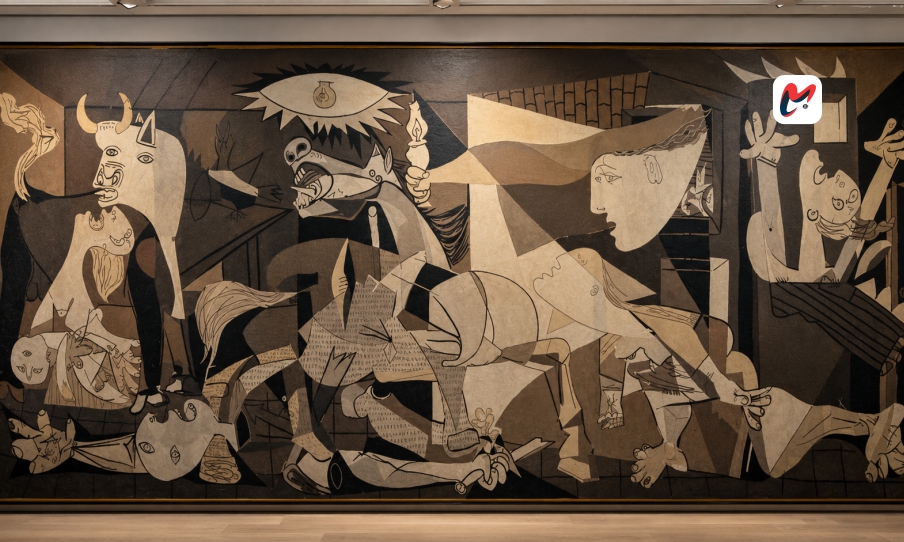
Art often depicts the emotions, beliefs, and struggles of society; however, only a few pieces go beyond their time and become a symbol of resistance. The painting guernica by Pablo Picasso is one of the most powerful visual statements created by an artist. Instead of promoting esthetic beauty and peace, this masterpiece screams about the horrors of war and remains relevant despite the passage of time.
A historically significant artwork, guernica by Pablo Picasso continues to inspire historians, artists, and politicians. The masterpiece is striking in its emotional impact, symbolism, and historical context, which make it one of the most memorable paintings in modern history.
The Historical Context of the Painting
In order to understand the deep meaning of Picasso’s work, it is necessary to learn the history behind it. The artwork was created in April 1937, as a result of the fascist forces of Nazi Germany and Italy attacking the city of Guernica during the Spanish Civil War. The forces loyal to Francisco Franco participated in the attack, while those opposing him remained helpless in front of the terror unleashed upon their homeland.
The atrocity became an awful reminder of the horrors occurring during war. The painting received worldwide acclaim, as the author managed to capture the pain of the people of Guernica and depict the terror associated with armed conflicts. In 1937, while living in Paris, Picasso was overwhelmed with emotions and decided to leave his artwork in the hands of fate. A piece originally intended for the Spanish Pavilion at the Paris World Fair was created to demonstrate the agony around the world.
Rather than depicting the event realistically, Picasso transformed it into an emotional and symbolic composition that could speak to audiences across cultures and generations.
Decoding the Powerful Symbolism
One of the reasons guernica by pablo picasso continues to fascinate viewers is its rich symbolism. Every figure appears to express pain, fear, confusion, or despair. The screaming mother holding her lifeless child has become one of the most heartbreaking images in modern art, representing the innocent victims of violence.
The bull, one of the painting’s most recognizable elements, has inspired countless interpretations. Some scholars believe it symbolizes brutality, while others associate it with Spain itself or even resilience. Similarly, the wounded horse in the center has been viewed as representing the suffering of ordinary people caught in the chaos of war.
The fractured bodies, distorted faces, and sharp geometric forms contribute to a sense of panic and destruction. Picasso deliberately avoided realistic proportions because he wanted to communicate emotional truth rather than literal accuracy. The monochromatic palette, dominated by black, white, and shades of gray, reinforces the bleak atmosphere and resembles newspaper photographs that first informed the world about the bombing.
The absence of color also prevents viewers from being distracted by aesthetic beauty, forcing them to focus entirely on the emotional impact of the scene.
Why the Painting Still Matters Today
Although decades have passed since its creation, guernica by pablo picasso continues to resonate because its message extends far beyond a single historical event. Civilian suffering remains an unfortunate reality in conflicts across the world, making the painting an enduring reminder of war’s human cost.
Museums, educators, and peace organizations frequently use the artwork to encourage discussions about violence, justice, and human rights. Students studying history encounter it alongside lessons about the Spanish Civil War, while art enthusiasts admire its revolutionary approach to visual storytelling.
The painting also demonstrates how creativity can become a powerful form of protest. Without depicting soldiers, weapons, or battle strategies in a conventional manner, Picasso communicated devastation more effectively than many written accounts. His work illustrates that art can influence public opinion, preserve historical memory, and provoke meaningful conversations long after political events have faded.
Its universal themes allow people from different backgrounds to interpret its symbols according to their own experiences, ensuring that every generation finds new relevance in its imagery.
The Lasting Legacy of Picasso’s Greatest Work
Today, guernica by pablo picasso is housed in Madrid’s Museo Reina Sofía, where it attracts visitors from around the globe. Millions travel specifically to witness its monumental scale and emotional intensity in person. Standing before the enormous canvas offers an experience that photographs simply cannot replicate.
Beyond museum walls, the painting has influenced countless artists, filmmakers, writers, and activists. Its visual language has inspired posters, murals, political cartoons, and contemporary installations addressing conflict and humanitarian crises. Even individuals with little knowledge of art history often recognize its iconic figures because they have become part of global culture.
The masterpiece also represents a turning point in Picasso’s own artistic journey. While he had already established himself as one of the pioneers of Cubism, this work demonstrated that modern art could communicate urgent social and political messages without sacrificing innovation. It proved that abstraction and symbolism could evoke empathy just as powerfully as realistic imagery.
More than eighty years after its creation, guernica by pablo picasso remains a timeless reminder that art possesses the extraordinary ability to document suffering, challenge injustice, and inspire hope. Its enduring legacy lies not only in its artistic brilliance but also in its unwavering call for humanity to remember the consequences of violence and to strive for a more peaceful future.