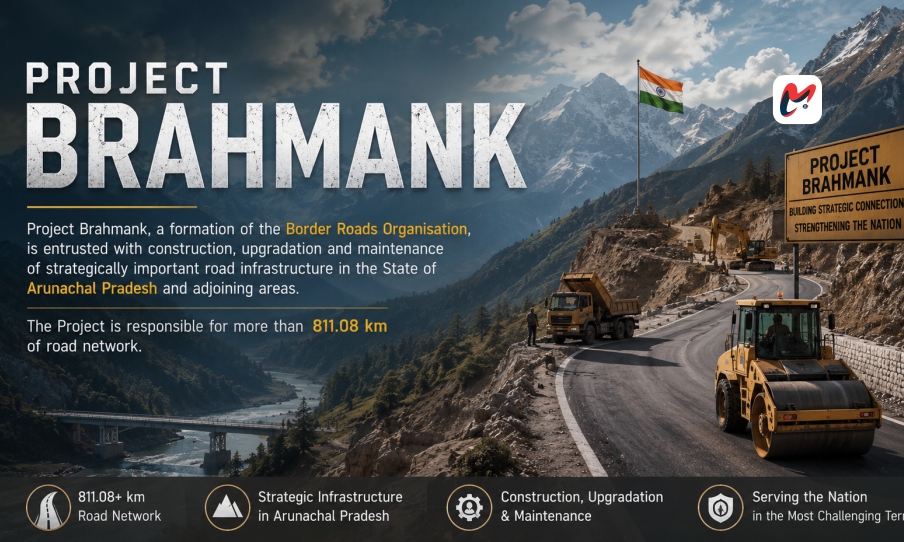
The northeast border of India poses as one of the most challenging terrains for infrastructure development. From high mountains and swift rivers to unpredictable weather, there are several difficult conditions to deal with while constructing roads in the region. However, the Border Roads Organisation has been working relentlessly to create and maintain lines of communication, which serve both strategic and developmental purposes. In the state of Arunachal Pradesh, there is a particular project called project brahmank, which has been a significant contributor towards fulfilling the objective. By constructing roads through mountains and building bridges over rivers, border roads organisation has made the area accessible to people within the country while securing the border.
The Background of Regional Connectivity
To understand the importance of the project, one has to look back at how it came to fruition. Project brahmank was raised from the Border Road Organisation in June 2011 at Ranaghat, East Siang, Arunachal Pradesh. The project was formed to have a dedicated wing for addressing the requirements of a strategically important region. In the past fifteen years, project brahmank has extended its reach to Siang, East Siang, West Siang, Upper Siang, Shi-Yomi, and some border areas of Dhemaji district of Assam. There is no doubt that working in such a region demands extreme perseverance from the personnel involved. Working on such a sensitive territory poses several challenges, including unpredictable weather conditions and natural calamities. Moreover, there are also human-made challenges such as political and strategic issues that hinder the smooth flow of operations. Heavy rains bring landslides that can undo the progress made by workers in a matter of hours.
The Engineering Marvels in Inhospitable Terrains
Building infrastructure in the Himalayas is never a straightforward task of laying down concrete. For the engineers steering project brahmank, every kilometer of road represents a battle against natural elements. The valleys of the Siang and Siyom rivers are notoriously difficult to navigate, yet project brahmank has successfully delivered permanent bridges that serve as vital links for heavy vehicular movement. Notable among these achievements are the hundred-meter steel arch bridge over the Siyom Nallah and the massive bridge over the Simang Nallah along the Along-Yingkiong axis. These structures are designed to withstand not just environmental stress but also the weight of heavy military equipment. Without the consistent intervention of project brahmank, many of these remote outposts would remain isolated for several months of the year, dependent entirely on erratic aerial logistics.
The Dual Role of Defence and Civilian Growth
The strategic importance of border roads is often viewed exclusively through a military lens, but the impact of project brahmank goes far beyond tactical readiness. While it is true that project brahmank provides the Indian Armed Forces with operational mobility to move troops and equipment swiftly to the Line of Actual Control, the civilian benefits are equally revolutionary. When a new road is blacktopped to national highway standards or a remote valley gets connected via a new steel bridge, an entire ecosystem of local trade, healthcare, and education opens up. Remote tribal villages gain direct access to advanced medical facilities in larger towns, and local farmers can transport their produce to markets without the fear of it spoiling during long, arduous journeys. This dual-use nature of the infrastructure highlights why project brahmank remains a cornerstone of comprehensive national integration.
Milestones and Future Infrastructure Horizons
The journey of infrastructure development is continuous, and recent milestones highlight the accelerated pace of work being undertaken in the region. During the recent working cycles, project brahmank has successfully completed the construction of over a dozen critical bridges across various valleys, alongside blacktopping long stretches of strategic roads to withstand heavy carriage. Furthermore, the development of tactical helipads under project brahmank has added a robust layer of multi-modal connectivity, ensuring that emergency evacuations and high-altitude logistics can be carried out seamlessly. As the Border Roads Organisation looks toward the future, the lessons learned and the assets created by project brahmank will continue to serve as a blueprint for frontier development, proving that human determination can overcome the most formidable geographical barriers.