Highlights
- South Korea says wealth generated by artificial intelligence must benefit the broader public, as policymakers confront rising labor tensions and economic concentration in the technology sector.
- Deputy Prime Minister Bae Kyung-hoon linked emerging AI-era labor conflicts to wider concerns around automation, inequality, and workforce disruption.
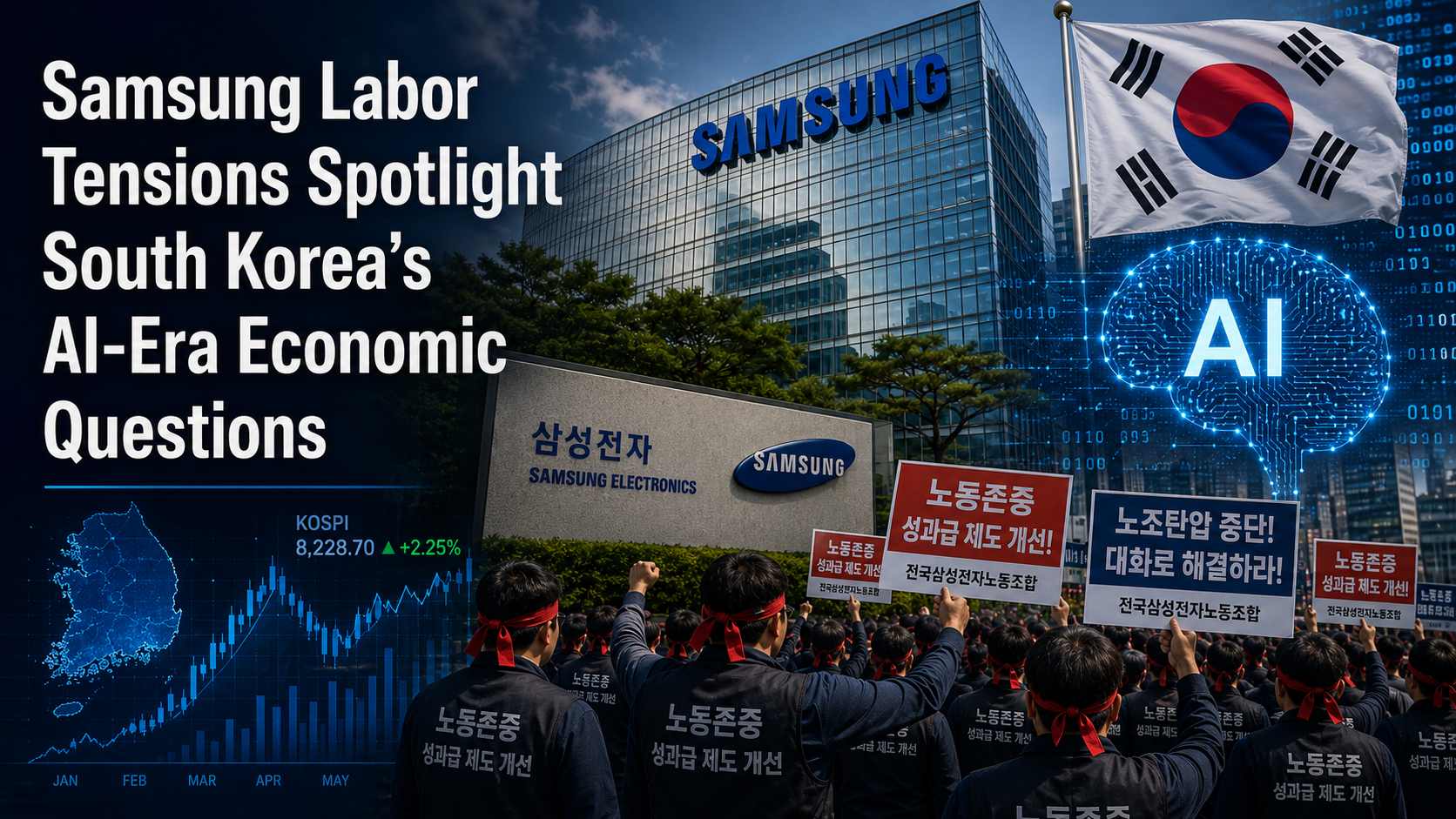
- The remarks come amid labor negotiations at Samsung Electronics, where a planned worker strike was temporarily suspended following government intervention.
- South Korea’s stock market rally continues to be heavily driven by semiconductor giants, raising questions around concentration risk and equitable economic participation.
- Seoul is positioning “AI inclusion” as a policy priority while expanding ambitions in semiconductors, robotics, and physical AI.
Key Takeaways
- AI wealth distribution is becoming a policy issue: Governments are increasingly debating who benefits from artificial intelligence-driven growth.
- Labor tensions reflect deeper technological disruption: Workplace conflict may intensify as automation reshapes industrial economics.
- Tech-led market concentration raises structural questions: Heavy dependence on major chipmakers creates both opportunity and vulnerability.
- South Korea wants AI leadership with social balance: Economic growth alone is not being framed as sufficient policy success.
- Physical AI becomes a strategic frontier: South Korea is expanding beyond semiconductors into robotics and real-world AI systems.
Core Background
South Korea is increasingly framing artificial intelligence not only as an economic growth engine, but as a public policy challenge centered on inclusion, labor stability, and equitable wealth creation.
Deputy Prime Minister Bae Kyung-hoon said governments must think beyond AI-driven wealth generation and focus on how the benefits of technological progress are distributed across society.
His comments arrive as labor tensions intensify at Samsung Electronics, where unionized workers recently pushed for stronger bonus protections and profit-linked compensation, reflecting broader concerns over how corporate gains are shared during periods of rapid technological expansion.
South Korean officials appear to view these labor disputes as early indicators of larger structural pressures that may emerge as artificial intelligence transforms major industries.
At the same time, South Korea’s equity markets have surged on investor enthusiasm around semiconductors and AI infrastructure, with dominant technology players driving much of the momentum.
That concentration has sparked debate over whether economic gains from the AI boom are becoming too narrowly distributed across sectors and corporate leaders.
Beyond software and chips, South Korea is also pursuing leadership in physical AI—the integration of artificial intelligence into robotics, vehicles, and industrial machinery—expanding its long-term strategic technology ambitions.
The broader policy message from Seoul is increasingly clear: success in the AI era will not be measured only by innovation and valuation growth, but by how effectively societies manage inequality, labor disruption, and inclusive participation in technological prosperity.
Read Also : Republicans Face Fresh Political Heat as Inflation Climbs