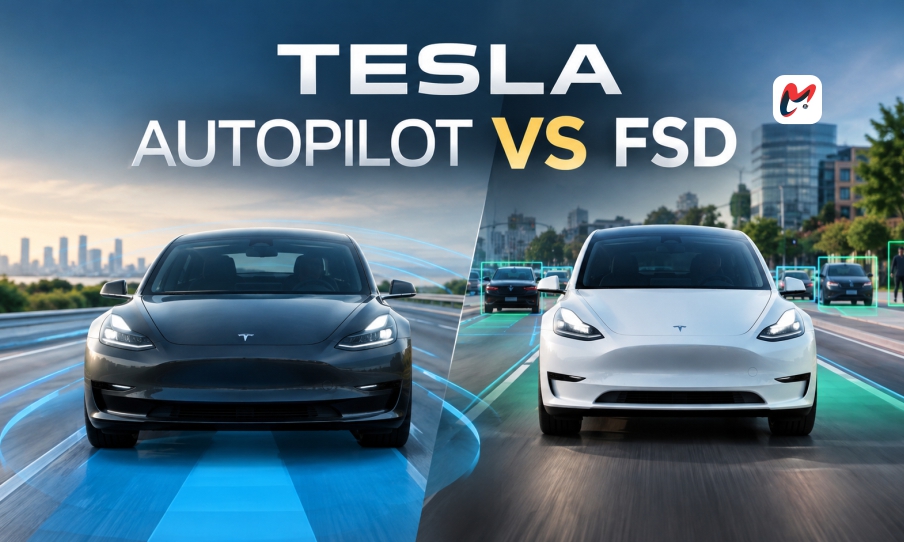
Since both Tesla Autopilot and Full Self-Driving may make a Tesla seem exceptionally powerful behind the wheel, it is easy to confuse the two. The names also imply a straightforward transition from minimal assistance to an autonomous vehicle, but the truth is more complex. In actuality, Tesla Autopilot and FSD are a comparison of two distinct levels of driving assistance, with FSD managing a far wider variety of driving responsibilities while still necessitating a careful human driver.
Tesla Autopilot vs FSD: The Basic Difference
The Standard Autopilot system serves the main function of handling acceleration and directional control. This feature of Traffic-Aware Cruise Control ensures that the vehicle continues to run at the said speed while also ensuring that Autosteer is helping the vehicle to steer within a designated lane. This means that Autopilot is particularly effective while on highways because the driving environment on highways is mostly predictable and lane markings can be read easily.
On the other hand, FSD Supervised seeks to achieve far greater outcomes. According to Tesla, this system is said to handle city roads along with highways, take left and right turns, change lanes, navigate through junctions, follow specified routes, react to traffic signals, and avoid obstacles. Hence, comparing Tesla Autopilot to FSD boils down to seeing which system accomplishes more tasks and what extent of assistance either system can provide while driving.
However, that does not mean that Tesla’s FSD is a fully autonomous driving system. As of now, Tesla defines FSD Supervised as an SAE Level 2 ADAS. This means that although FSD is capable of completing impressive driving maneuvers, the responsibility for driving still remains with the owner of Tesla and they are obliged to when necessary.
Lane Changes Are Where the Gap Becomes Obvious
The lane changing functionality exemplifies the differences between Tesla Autopilot and FSD features. While basic Autopilot only allows the car to remain within its lane, some Tesla series and configurations provide the ability to change lanes automatically either through Auto Lane Change or Navigate on Autosteer which can provide help on the highway. Although these features can facilitate jumping from one lane to another, they are still far less competent than the FSD.
The FSD Supervised system is capable of changing lanes autonomously depending on the route and other vehicles on the road. In the company’s spokesman’s own words, FSD is able to choose the right lane, take the highway exits, and go in turns on the road without the driver’s approval on each move. However, the driver is still free to intervene if he/she disagrees.
Moreover, Tesla introduced various profiles which affect how often the changing of lanes is conducted by the system. In the case of a relaxed profile, the number of lane changes will be less compared to the case of aggressive profile which encourages the frequent switching of lanes while driving.
Navigation Turns FSD Into a Different Kind of Assistant
Another crucial distinction between Tesla’s Autopilot and FSD is the aspect of navigation. Autopilot usually achieves its aim of maintaining speed and position of the car instead of carrying out the whole journey by itself. On the other hand, FSD is capable of taking into account the final destination input into its navigation system. Therefore, the system is able to take turns, cross intersections, manage roundabouts, and traverse exits on highways. Thus, FSD attempts to continuously control multiple tasks related to driving, making it an advanced driving assistance technology.
The software update launched in July 2026 has introduced improvements in navigation, merging, turning, dealing with pedestrians, traffic lights, and other cars and their movements. The update provides evidence of Tesla’s commitment to continuously develop its FSD technology instead of regarding it as a set of features as it is with regular driver-assisted systems.
Parking Shows Another Side of the Comparison
The first thing to clarify is the role that parking plays in this comparison of Tesla Autopilot and FSD. It is far more than just a matter of highway driving because the fully developed FSD includes features such as Autopark. Indeed, the latter helps to parallel and perpendicular park. Apart from that, Tesla offers its customers such service as Actually Smart Summon, which is capable of moving the car in special parking positions in order to meet the driver.
This is where the practicality of Tesla self-driving technologies comes into play. Highway support can be valuable during long journeys, but parking assistance helps to deal with other problems on the road. Since driving in crowded parking lots and in confining spaces require different techniques, Tesla seeks balance between those approaches.
The company’s ambitions in software development for 2026 are also proving that parking becomes an integral part of the FSD experience. Tesla representatives claim that the rollout of FSD v14 lite has been accompanied by such options as “parking at destinations” (i.e. parking in a lot, parking on the street, parking at the curb, parking at driveway).
Traffic Lights, Stop Signs and the Harder Problem of Judgment
Perhaps the most thorough explanation of Tesla Autopilot vs. FSD should be given to traffic control. While FSD is intended to read traffic lights, stop signs, intersections, and the actions of nearby road users as part of a larger driving duty, autopilot can offer traffic-aware speed and steering assistance. According to Tesla, FSD can react to cars, bicycles, and pedestrians as well as slow and stop at traffic lights and stop signs.
These studies show why the term “supervised” is so crucial, yet they do not negate the technology’s potential. It is never appropriate to compare Tesla Autopilot and FSD as “driver assistance versus a completely autonomous car.”
Which One Actually Matters More to Drivers?
In case you are just someone who prefers assistance that will make it easier to keep your speed and position on the highway, you should find Standard Autopilot fully compliant with your needs. In contrast, if you would like the car to take part in planning your itineraries, performing lane changes, driving in the city, navigating through junctions and parking, FSD would offer you a lot more.
To understand clearly how Tesla Autopilot is different from FSD, we need to forget about the one that drives better in any given situation. The correct question is just how responsible each piece of software is and how comfortable the driver feels with supervising this work of software.
According to the information provided by Tesla itself, the software of FSD Supervised has now served its purpose on public roads for over 10.5 billion kilometers worldwide, which reveals the tremendous scale of the development and testing of the system by way of customer driving. However, the scale does not eliminate the demand for the people’ involvement in the process.
In the end, this is what distinguishes the futuristic notion of a fully autonomous car from Tesla Autopilot vs. FSD. Even though FSD can handle a shockingly high portion of the driving workload, humans are still the last line of defense. As of right now, it’s best to use either system as an increasingly capable driving companion rather than as a substitute for the human operating the vehicle.