
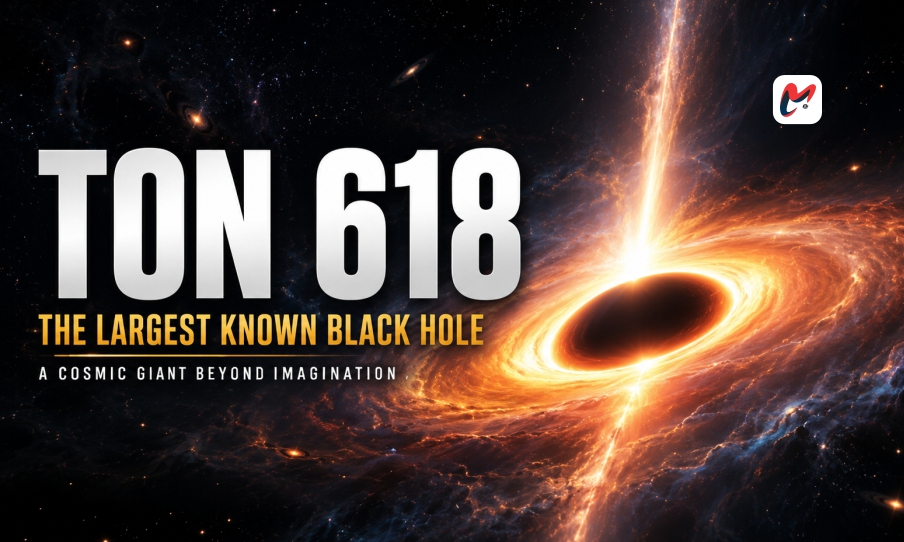
The universe contains many interesting features, but it is hard to find something that will surpass TON 618. The first thing that might catch an observer’s eye is that it was formed around one of the biggest black holes in the universe. The main reason why it has become so famous among astronomers is that it is a quasar, meaning it is an extremely luminous center of a galaxy that is powered by a supermassive black hole.
Since the object is located tens of billions of light years away from us, the chance to observe it gives scientists an insight into how the early universe looked like and how it evolved from the time of the Big Bang. The characteristic of TON 618 that seems unbelievable is its size – this quasar continues to challenge the existing theories concerning black holes. With new discoveries, telescopes, and other equipment, astronomers continue to seek answers about this object that rules over its surroundings.
The Discovery and Nature of TON 618
In 1957, when Braulio Iriarte and Enrique Chavira, two astronomers working at the Mexican Tonantzintla Observatory, catalogued the region of the sky where TON 618 is located for the first time, the only thing they thought it was was a blue star. But the next time they observed it – and, more importantly, scientists got another chance to look at it – in 1970, everything changed. An international research team made a radio survey in Italy when they noticed radio waves coming from TON 618. It turned out that it was not a star at all – it was a quasar, and a very bright one at that.
A quasar is a type of active galactic nucleus (AGN), which forms when enormous amounts of gas, dust, and other material spiral toward a supermassive black hole. Before this matter crosses the event horizon, it forms an extremely hot accretion disk. Friction within the disk generates tremendous heat, producing enormous amounts of visible light, ultraviolet radiation, X-rays, and radio waves. In many cases, the quasar becomes so bright that the surrounding galaxy is almost impossible to observe directly.
Why Quasars Shine So Brightly
Unlike ordinary galaxies, active galactic nuclei produce immense amounts of electromagnetic radiation from their central regions. This happens because matter falling toward the black hole is compressed and heated to extraordinary temperatures. Instead of the black hole itself emitting light, the glowing material around it creates the spectacular brightness astronomers observe.
Not every galaxy hosts an active nucleus. Our Milky Way, for example, contains a supermassive black hole called Sagittarius A*, but it is relatively quiet because there is little nearby material left to consume. Without a continuous supply of gas and dust, the central region emits only modest radiation.
Quasars represent the most energetic members of the AGN family. Other categories include Seyfert galaxies, radio galaxies, and LINERs, each differing in their radiation characteristics and spectral properties. Quasars stand apart because they outshine their host galaxies by an enormous margin, making them visible across billions of light-years.
Scientists believe that active galaxies eventually become less energetic as their central black holes consume the available matter. Once the surrounding fuel is exhausted, radiation decreases significantly, leaving behind a quieter galactic core.
The Extraordinary Scale of This Cosmic Giant
One reason TON 618 continues to capture scientific attention is the unbelievable size of the black hole powering the quasar. Current estimates suggest it possesses a mass approximately 40 billion times greater than our Sun. To appreciate this scale, imagine compressing the mass of tens of billions of suns into a single gravitational object.
Its estimated diameter extends roughly 30 to 40 times wider than our entire Solar System. Even at the speed of light, crossing such an enormous region would take several days. Numbers like these stretch the limits of human imagination and demonstrate just how diverse black holes can become.
The quasar is located around 18.2 billion light-years from Earth in the constellation Canes Venatici. Because light requires time to travel, astronomers are observing it as it existed billions of years ago, providing a glimpse into the distant past of the universe.
The immense gravitational pull generated by this ultramassive black hole drives the continuous flow of surrounding matter into the accretion disk. This process releases staggering amounts of energy, making the object one of the brightest known quasars despite its unimaginable distance.
Is It Really the Largest Black Hole?
Many astronomers consider TON 618 one of the strongest contenders for the title of the largest known black hole. However, determining the “largest” depends on how scientists compare these objects. Measurements involve estimated mass, event horizon size, and observational uncertainties, which can vary between studies.
Other enormous candidates include Phoenix A*, SDSS J140821.67+025733.2, and the ultramassive black hole associated with the galaxy Abell 1201. Each possesses extraordinary characteristics, and ongoing research continues to refine mass estimates using improved observational techniques.
Another intriguing feature is the detection of intense Lyman-alpha radiation surrounding the quasar. This ultraviolet emission originates from neutral hydrogen and suggests the presence of a massive cloud of gas known as a Lyman-alpha blob. Such structures help astronomers investigate the environments of young galaxies and the large-scale distribution of matter in the early universe.
Although much remains unknown about its host galaxy, continued observations using powerful ground-based observatories and advanced space telescopes are expected to reveal new insights into its formation and evolution.
A Window into the Early Universe
Studying TON 618 is about far more than identifying an exceptionally large black hole. It helps scientists understand how supermassive black holes formed, how galaxies evolved over cosmic history, and why some galactic centers became extraordinarily active while others remained relatively quiet. Every new observation improves our understanding of gravity, galaxy formation, and the extreme physics operating in the universe.
As astronomical technology advances, this remarkable quasar will continue serving as an important laboratory for exploring some of the biggest unanswered questions in modern astrophysics. Its immense size, incredible brightness, and ancient light make it one of the most fascinating objects ever discovered beyond our galaxy.