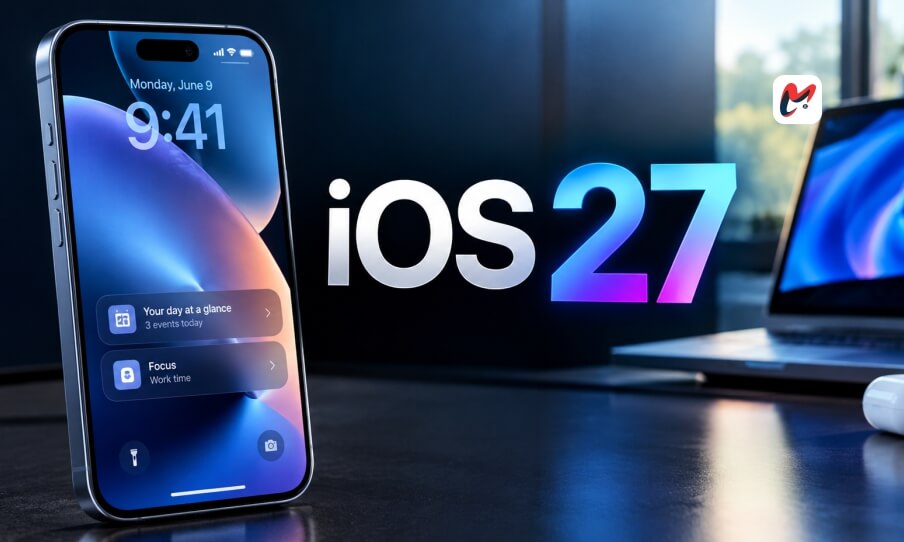
Siri was helpful for many things in the past, such as setting alarm clocks, getting the weather, sending simple text messages, and answering basic questions. However, the introduction of iOS 27 marks a significant step. Apple has finally launched a new system and placed Siri at the center of it, moving the service from being just a voice-activated service to becoming an actual layer of personalization on the iPhone. The new software is available starting from September 14, 2026, and the first version of Siri AI is presented in English as part of the beta-version of the new program.
In this regard, the major change is that Siri is finally capable of understanding more complicated questions. With the introduction of iOS 27, Siri can easily grasp user’s personal context, comprehend the information user is looking at, search through data in applications, understand information available on the web, and perform a number of actions in different applications.
iOS 27 Makes Siri More Aware of Your Personal Context
The feature that will be the most practical part of iOS 27 is also the one that will probably change the most the way we live daily lives: understanding of personal context. According to Apple, Siri is able to search messages, photographs, emails, and all kinds of personal information, in order to find something related to a request. After this, Siri can perform actions across applications, rather than just show the relevant data.
Let us take an easy example: for the case when you need to remember the name of a restaurant someone advised you to visit a few months ago. Instead of going through the entire history of messages, photographs, notes, and emails, a user can just ask Siri.
The invention does not look to be too useful at first glance, but it seems as if a user will get used to it eventually. There is a lot of hindrances connected with the need to remember which application contains a particular piece of information. With iOS 27, the operating system itself starts to be a source of information for a user.
Onscreen Awareness Could Change How You Interact with Apps
One of the important developments has to do with Siri’s capacity to understand what is on the iPhone screen. Apple calls it onscreen awareness since it allows Siri to respond to questions that require knowledge about visible information on the screen along with applying the knowledge while responding.
This means that users do not need to tell everything. For instance, if someone has sent an address in the Messages app, users can ask Siri questions about the place without manually copying the text to another app. If there is a visual with objects or information that you do not know, Siri will know how to figure it out using the context.
Apple applies the same idea in Camera-based Visual Intelligence. The new system in iOS 27 enables Siri to work when the Camera is in use. It means that users can point the phone camera at something and ask questions about it. In Apple’s example, the camera can be used to receive information related to the food.
Thus, the camera is not a passive device anymore and is able to become an interface for asking questions about what is going on in the world.
Siri Can Finally Become More Conversational
While the conversational updates in iOS 27 appear straightforward, they could achieve great things in changing how people actually utilize Siri. Apple claims that Siri AI facilitates a more natural communication process, making it possible for users to hold conversations with Siri just like they would their friends.
It means that users are not considered limited to issuing commands to Siri. Instead of saying something like, “Set a timer for 10 minutes,” users can sketch the idea and continue with their own thoughts.
The reasoning behind this is that it makes use of a completely different concept of how users think and, therefore, express their needs. The innovation in iOS 27 is important because it meets user expectations. People expect that their devices will be able to hear a conversation and comprehend meaning of the following message.
Writing tools make iOS 27 even better in terms of practical use. Не will be capable of creating a first draft of a letter, altering the text, and implementing other helpful methods. As a result, instead of writing something themselves in an app, Apple users can have Siri generate a text of their typical emails according to their usual style, punctuation patterns, and practices on the matter.
Additionally, Apple has incorporated writing support and proofreading across the entire system. The overarching objective is to assist users in making changes to previously published content rather than only producing text. In this way, rather than seeing AI as a distinct chatbot, iOS 27 views it as an editing layer that is closer to the keyboard.
The Real Change Is the Way You Think About the iPhone
What is interesting about iOS 27 is that its major innovation is not a new icon or a new personalization feature. It is the ability for users to abandon thinking in terms of apps.
Instead of the sentence “I need to launch the Photos app and find the photo I need to copy the information from it. Then I need to send it,” the user might say, “Find the photo and send it.” Instead of sifting through past conversations to search for the information needed, a person needs to ask Siri for help. Instead of researching something that the camera shows, they have to point their iPhone at it and ask.
And this is the way where Apple is heading. iOS 27 transforms Siri from a command-based assistant to a layer connecting a range of personal data making use of various applications, visual information, and knowledge base. At the moment the technology is in beta version so its reliability will be of equal importance together with its functionality. However if Apple manages to develop the technology so that its use is accessible, immediate and secure, Siri will finally turn into what people use not because of its commands.
That is the true promise with iOS 27. It’s possible that the most significant AI feature isn’t a particularly amazing new technique. It might be an iPhone that involves less app switching, copying, searching, and remembering where everything is kept. The way people use their iPhones could alter more significantly than the yearly software update cycle indicates if Siri can reliably perform that invisible task.