
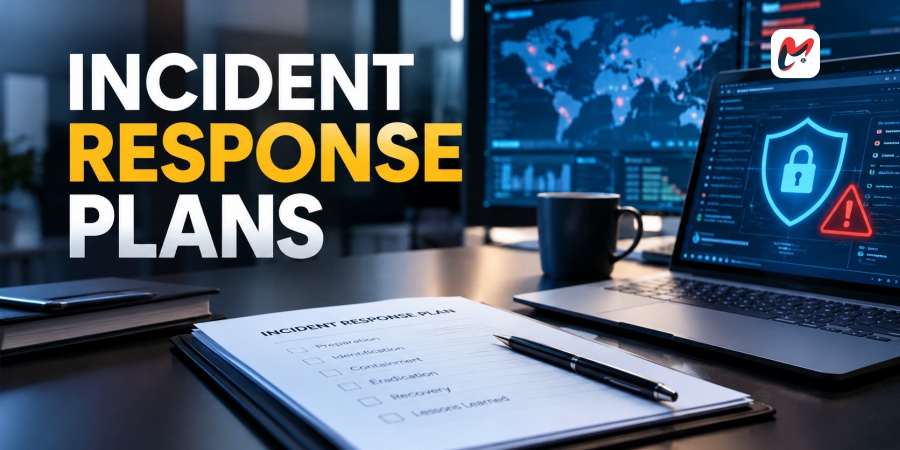
A small business does not need a security operations center to be prepared for a cyberattack. It does, however, need to know what happens when an employee clicks a convincing phishing link, ransomware appears on a shared drive, a business email account is taken over, or a laptop containing customer information disappears. That is where incident response plans become practical rather than theoretical. A well-designed plan gives a small team a way to make decisions under pressure without waiting for someone to figure out the process during the crisis.
The need is becoming harder to ignore. Verizon’s 2026 Data Breach Investigations Report says 31% of breaches now begin with exploitation of software vulnerabilities, while ransomware appears in 48% of breaches. The report also highlights that 15% of attack techniques are being augmented by generative AI. These figures cover organizations broadly, but Verizon also provides a dedicated SMB analysis, reflecting the distinct risks faced by smaller companies.
Why Incident Response Plans Matter Without a SOC
The absence of a SOC does not mean a business can afford to improvise. In fact, limited staffing can make preparation more valuable because the same person may be responsible for IT, operations, customer communication, and vendor coordination.
Good incident response plans do not need dozens of pages of technical instructions. They need clear decisions and ownership. Someone should know who has authority to isolate a device, who contacts the managed service provider or cybersecurity specialist, who communicates with customers, who speaks with legal counsel, and who keeps a record of what happened.
The Federal Trade Commission recommends that businesses create a cybersecurity incident response plan and distinguish it from disaster recovery and business continuity planning. Its guidance also calls for plans to be tested and updated as circumstances change.
Start With the Incidents You Can Actually Imagine
One of the mistakes small businesses make is creating incident response plans around every conceivable cyber threat. A better starting point is the handful of scenarios that could realistically interrupt the business.
Consider a company whose accounting employee reports that an unfamiliar person accessed the business email account. The first questions should already have answers. Who takes control of the investigation? Should the account be disabled or its sessions revoked? Does the attacker have access to cloud storage? Are payment instructions at risk? Which customers or suppliers need to be contacted? Has any information been downloaded?
A ransomware scenario needs a different immediate response. The priority may be isolating affected machines and preventing the infection from spreading while preserving evidence and determining whether backups are available. The FTC similarly advises businesses to disconnect a compromised computer from the network and investigate incidents promptly.
Build a Small Team Around Clear Responsibilities
The strength of incident response plans often comes down to clarity rather than technical sophistication. A five-person company can assign responsibilities just as effectively as a large organization if everyone understands their role.
The owner or senior manager might make business decisions and approve external communication. An internal IT employee or managed service provider can handle containment and technical investigation. A legal adviser can help determine notification obligations, while an insurance contact can coordinate with a cyber insurer if coverage exists. A communications lead can manage employees, customers, suppliers, and public statements.
The important point is to identify these people before an incident. Their phone numbers, email addresses, backup contacts, vendor details, insurance information, and relevant account information should be available even if the company’s primary systems are inaccessible.
Make the First Hour Simple
During an incident, complicated incident response plans can become difficult to follow. The first phase should therefore concentrate on stabilizing the situation.
Suppose an employee discovers ransomware encrypting files on a workstation. The employee should know whom to contact immediately and understand that continuing to experiment with the affected machine may make the situation worse. The response team can then determine which systems need isolation, whether shared drives are affected, whether backups remain accessible, and whether external specialists should be called.
Documentation matters at this stage. Record the time the incident was discovered, what was observed, which devices or accounts were involved, and what actions were taken. The information can later help investigators reconstruct the event and determine whether notification or regulatory requirements apply.
Test the Plan Before the Real Incident
Writing incident response plans is only the beginning. A small business can conduct a short tabletop exercise without purchasing expensive technology. The owner, IT provider, and relevant employees can spend an hour walking through a fictional scenario and asking what they would do next.
Imagine that the company’s Microsoft 365 administrator account has been compromised on a Friday afternoon. Can someone identify the account owner? Can access be suspended? Does anyone know how to contact Microsoft support or the managed service provider? Where are backup contact details stored? Who decides whether customers need to be informed?
Questions like these expose gaps quickly. The FTC’s Safeguards Rule, where applicable, specifically calls for written response procedures covering roles, communications, documentation, remediation, and post-incident review.
Keep the Plan Short Enough to Use
The most useful incident response plans are living documents. They should change when employees leave, vendors change, applications move to the cloud, or the company starts collecting new types of sensitive information.
A small business does not need to recreate the structure of a multinational security organization. It needs a dependable chain of decisions, reliable contacts, practical containment steps, tested backups, a communication process, and a way to learn from every incident.
That is ultimately what makes incident response plans valuable without a SOC. The objective is not to predict every attack or eliminate every risk. It is to make sure that when something goes wrong, the business does not lose precious time deciding who should act, what should happen first, and how the organization will continue operating. Preparation turns a chaotic security event into a problem with a process, and for a small company, that difference can be significant.