Highlights
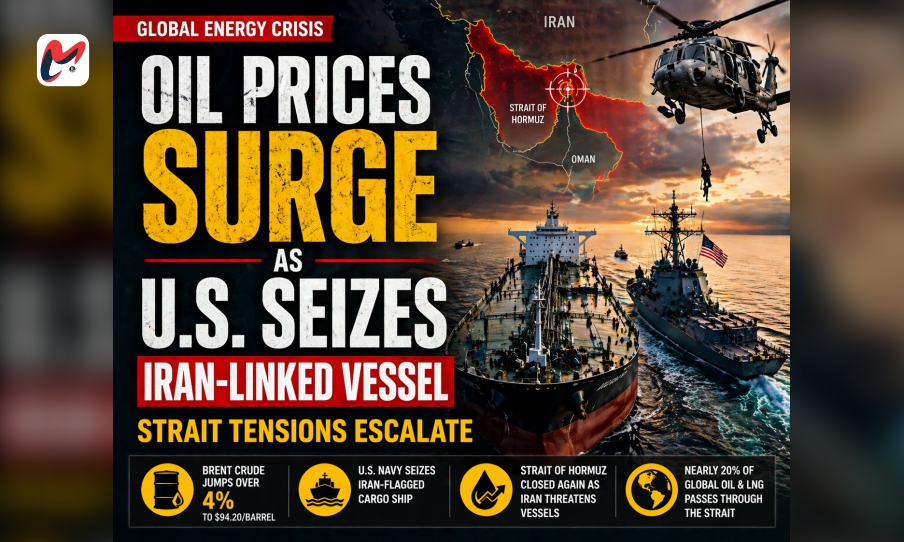
- Global oil prices surged after Donald Trump announced that U.S. naval forces intercepted and seized an Iran-flagged cargo ship.
- Brent crude jumped over 4%, reaching $94.20 per barrel and reversing the previous decline.
- Iran closed the Strait of Hormuz again and warned it would target approaching vessels.
- The Strait, which carries nearly 20% of global oil and LNG supply, remains at the center of escalating tensions.
- Energy markets continue to react sharply to rapid geopolitical developments and policy signals.
Key Takeaways
- The conflict uses military power and political signals to determine global oil prices.
- The Strait of Hormuz suspension creates a dangerous complete closure of a vital international energy transportation route.
- The market experiences rapid price changes because of sudden policy alterations and unexpected communication events.
- Energy shortages together with increasing prices create economic challenges that particularly impact Asian countries.
- The diplomatic process remains blocked because of contradictory information that needs to be solved before the negotiations can reach an agreement.
Core Background
The United States increased international tensions when its navy captured an Iran-linked cargo ship which immediately impacted worldwide energy markets. Iran established its territorial claim by closing the Strait of Hormuz which serves as one of the most essential oil transportation routes in the world.
The waterway serves as a transportation route that delivers one-fifth of the world’s oil and liquefied natural gas. Supply chain disruptions result in major restrictions which create market price fluctuations.
Iran issued a warning that it would begin attacking ships that entered the area after the closure, which raised the danger level for worldwide maritime operations. The United States and its allies launched military operations to counter Iran, which resulted in Tehran threatening retaliatory actions. Both parties engaged in strategic operations while using signaling practices to demonstrate their authority, which caused energy markets to respond in real time.
The situation continues to be uncertain because diplomatic efforts have not succeeded yet. U.S. officials plan negotiations, but Iran has not confirmed participation, which creates uncertainty about whether the two sides will reduce tensions. The U.S. continues to operate its naval forces in the area, which serves to increase pressure throughout the region.
The impact of the situation spreads beyond the immediate war area. The Asian economies which depend on energy imports that pass through the Strait face severe operational challenges. The regional governments have enacted energy conservation policies through measures that include decreased working hours, work-from-home arrangements, and restriction of energy usage. The global markets demonstrate this market instability through their current performance.
Oil prices have experienced extreme movements, starting at approximately $70 per barrel before the conflict and reaching their maximum of almost $120. The stock markets in Europe and the U.S. have shown mixed results, which include negative performance, while some Asian markets have proven to be strong. The crisis has already triggered larger alarms about fuel shortages and disruptions in supply chains.
According to industry leaders, extended blockades will result in flight cancellations, which will harm the economy, especially in areas that rely on energy resources. The ongoing tensions demonstrate an essential fact that strategic energy route control through the Strait of Hormuz determines worldwide economic stability.