
Highlights
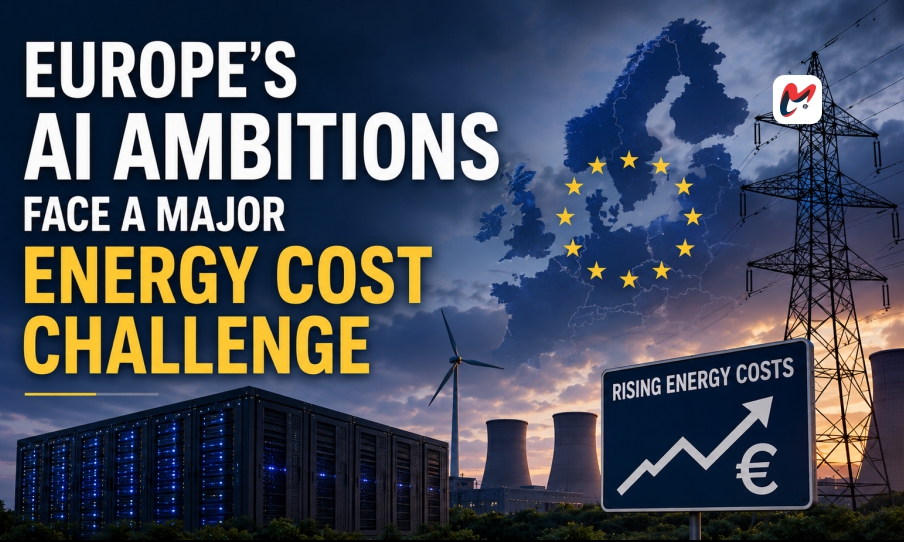
- Europe’s ambitions to become a global artificial intelligence leader face a major obstacle: high energy costs.
- AI data centers require enormous electricity consumption, making energy affordability a decisive factor in infrastructure investment decisions.
- Industry experts warn that Europe risks losing major AI infrastructure projects to lower-cost regions such as the U.S. and China.
- Nordic countries and France are emerging as stronger regional contenders due to relatively cheaper power and more resilient energy mixes.
- Rising electricity demand from AI infrastructure could intensify political and public resistance as national grid pressures grow.
Key Takeaways
- Energy has become an AI competitiveness issue: Compute leadership increasingly depends on affordable, scalable electricity access.
- Europe faces an infrastructure disadvantage: High power prices and slower deployment timelines weaken its AI expansion ambitions.
- Not all European markets are equally positioned: Lower-cost regions could capture disproportionate investment while others fall behind.
- AI may reshape energy economics: Data center expansion could drive broader electricity inflation and alter digital service pricing.
- Technological sovereignty depends on power strategy: Europe’s AI ambitions now intersect directly with energy security and industrial policy.
Core Background
Europe’s push to compete with the United States and China in artificial intelligence development faces a structural challenge that extends beyond software and chip access: electricity economics.
As governments and technology companies accelerate AI infrastructure expansion, data centers have emerged as one of the most energy-intensive pillars of digital growth.
These facilities demand large-scale, continuous power consumption, making location decisions increasingly dependent on energy pricing, grid reliability, and deployment speed.
Experts warn that Europe’s comparatively high electricity costs place the region at a disadvantage in attracting major AI infrastructure investment, particularly when competing against markets with cheaper energy and faster project execution.
The issue carries strategic significance because AI leadership increasingly depends not just on algorithms, but on physical compute infrastructure capable of supporting model training and large-scale deployment.
Some European regions may still benefit. Countries with lower electricity prices, abundant renewable capacity, and stronger energy resilience—particularly in the Nordics and parts of Western Europe—are emerging as more attractive destinations for hyperscale AI investment.
At the same time, rapid data center expansion creates broader economic concerns, including higher grid stress, rising consumer electricity costs, and growing local political resistance.
The debate reflects a wider shift in global technology competition: access to affordable energy is becoming as critical to AI dominance as access to capital, talent, and advanced semiconductors.
For Europe, the AI race may ultimately hinge as much on energy strategy as on digital innovation itself.
Read Also : United Flight Attendants Approve New Contract With 31% Pay Raise